.png)


“With our port investment, we have transformed into an industrial ecosystem that produces, exports, and opens up to the world.”


Batuhan Ekinci - Commercial Coordinator of Ekinciler Group
Ekinciler Iron and Steel Industry Inc., one of Türkiye's leading iron and steel producers, continues its operations with an annual production capacity approaching 1.5 million tons, environmentally friendly technologies, and a production approach in line with international quality standards. Batuhan Ekinci, Commercial Coordinator of Ekinciler Holding, stated in his remarks to Demir Çelik Store that with the recently completed new investments, their port capacity has reached 12 million tons, adding, “We have become one of the largest private ports in the Eastern Mediterranean. By creating significant speed and cost advantages in logistics processes, we are making our export operations even more efficient. With this port investment, Ekinciler is transforming into a significant brand in the world in terms of iron and steel and logistics supply.”
Could you tell us about Ekinciler Demir Çelik and yourself?
Ekinciler Iron and Steel Industry Inc. (EKDEMİR), operating under the umbrella of Ekinciler Holding, whose roots date back to the 1960s, is one of Türkiye's oldest and leading steel producers. Founded in Adana in 1964 by the late Ali Ekinci as Ali Ekinci Trading House, its establishment quickly transformed into a powerful industrial movement thanks to the visionary approach of its founder, who recognized the strategic role of industry in the country's development early on.
A milestone in our brand's growth journey...
"The plant, which was commissioned in Iskenderun in 1983 and was the first privately owned steel plant investment in the region, plays a significant role."
Ekinciler, which increased its production capacity with the rolling mill commissioned in Karabük in 1976, quickly integrated its foreign trade and logistics activities and became one of the first integrated iron and steel structures in the region.
The region's first privately owned steel plant, which began operations in Iskenderun in 1983, marked a turning point in our brand's growth journey, positioning Ekinciler among the global representatives of Turkish steel.
Today, Ekinciler Iron and Steel continues its operations with an annual production capacity approaching 1.5 million tons, environmentally friendly technologies, and a production approach that complies with international quality standards. Our production infrastructure, which can respond to international demands in every quality of steel, also enables us to produce steel solutions that add value to structures with high earthquake safety.

“Eksismik Plus: Türkiye’s first patented earthquake-resistant construction steel brand”
Developed in line with this vision, Eksismik Plus, Türkiye's first patented earthquake-resistant construction steel brand, forms the foundation of safe and sustainable structures with its superior strength, low carbon footprint, and innovative production technology. Guided by our experience of over half a century and guided by the vision of "From Heritage to the Future," Ekinciler Iron and Steel continues to represent Türkiye's industrial strength on a global scale with unwavering commitment to quality, reliability, and sustainable production.
“Ekinciler Port stands out as an infrastructure that supports our group's industrial and commercial synergy.”
As Ekinciler Iron and Steel celebrates its 60th anniversary in the sector, what were the main factors behind this successful journey?
In 1983, the commissioning of the region's first private steel plant in Iskenderun cemented our production capacity in the history of our industry. Following this growth, in 1985, the establishment of EKMAR Maritime and Ship Agency Inc. created a strong trade channel opening up to international logistics markets; thus, we became a highly competitive player not only in production but also in the global steel trade.

“With our recently completed new investment, our port capacity has reached 12 million tons.”
Today, Ekinciler Port, one of the most strategic elements of this integrated structure, stands out as an infrastructure supporting the industrial and commercial synergy of our group. With our recently completed new investment, our port capacity has reached 12 million tons, making it one of the largest private ports in the Eastern Mediterranean. This investment represents not only an increase in capacity but also a significant leap in efficiency in logistics, environmental sustainability, and international competitiveness. Today, Ekinciler Iron and Steel operates as a "producing, exporting, and globally opening industrial ecosystem" with its structure integrating production, trade, and logistics activities under one roof. Behind this journey of success lies a rich legacy of over sixty years, as well as a management approach that correctly interprets change and evaluates technology with a focus on sustainability.
“In our modern facilities, we produce high-strength and high-quality reinforcing steel that meets international standards.”
What activities does your company undertake, and can you tell us about the products and services you offer your customers?
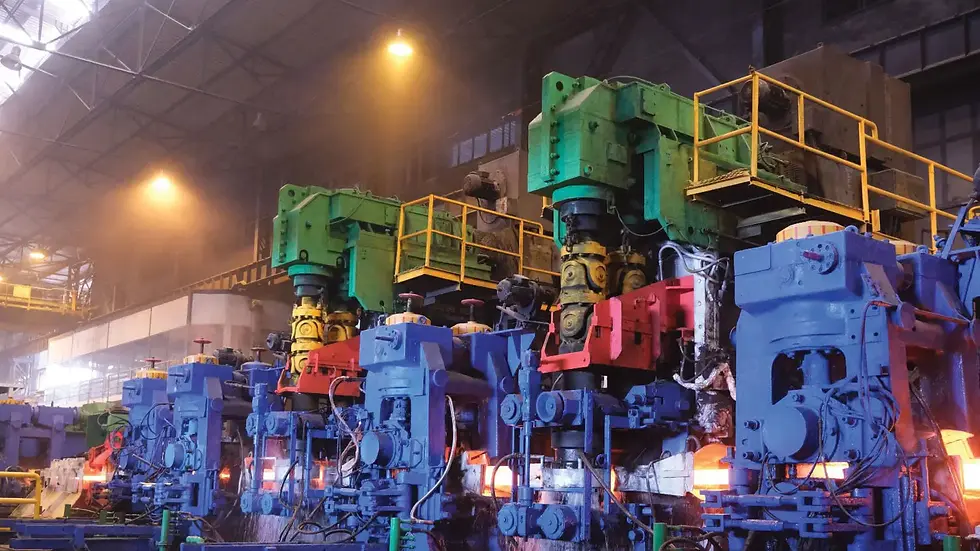
Our main product is reinforcing steel. In our modern facilities, we produce high-strength and high-quality reinforcing steel that conforms to international standards; serving a very wide range of applications from infrastructure projects to housing, industrial structures to bridge, road and port projects. One of the most important elements of our production capacity is the monoblock rolling technology we use in our rolling mill. Thanks to this technology, we can produce lighter reinforcing steel within the tolerance ranges allowed by standards and obtain more product in the same tonnage. This feature makes us the preferred choice, especially in earthquake-resistant building constructions. In addition, the monoblock system, with its high process control and homogeneous production structure, increases the strength values of our products to above international standards.
“We regularly export to more than 60 countries, primarily in the Middle East, Central and East Africa, and Europe.”
Thanks to our advanced production technologies, quality control systems, and customer-focused approach, our products are in high demand both domestically and in export markets. We regularly export to over 60 countries, primarily in the Middle East, Central and East Africa, and Europe. Furthermore, in line with our commitment to sustainability, we conduct our production activities using environmentally friendly and energy-efficient processes. Customer satisfaction has always been our top priority. We are determined to maintain our strong and stable position in the sector by continuously improving our product range and quality standards.
“Our strong shipments to Syria, Yemen, Cyprus and African countries have maintained our export balance.”
How did your company fare in terms of production and exports during the first nine months of 2025? What are your targets and expectations for 2026?
The first nine months of 2025 were a successful period in terms of production continuity, stability in export performance, and efficiency in cost management, despite challenges in global steel markets. In the domestic market, the vibrancy of urban transformation and infrastructure investments supported our production volume, while strong shipments to Syria, Yemen, Cyprus, and African countries enabled us to maintain our export balance. “The new capacity of our port provides a significant speed and cost advantage in the logistics process.”
During this period, our annual capacity, approaching 1.5 million tons, was utilized with high efficiency, and energy consumption and carbon emissions were reduced through investments in environmentally friendly technologies and automation in production processes. Furthermore, the new capacity of Ekinciler Port, reaching 12 million tons, created significant speed and cost advantages in logistics processes, making our export operations more effective.
In terms of export geographic distribution, our business volume has increased in many markets, especially in nearby markets such as Syria, Yemen, and Cyprus. The strengthening of our trade network in these regions has enabled our brand to stand out with its durable, reliable, and sustainable steel solutions.
Our 2026 Strategy: “To strengthen a growth model focused on high value-added and green production”
Our strategic priority for 2026 is to further strengthen our growth model focused on high value-added and green production. In line with this, we aim to increase the export share of our Eksismik Plus brand earthquake-resistant construction steels, and accelerate investments in digital transformation and energy efficiency in our production processes. With the ongoing digitalization and site expansion projects at Ekinciler Port, we plan to transform our logistics structure into a regional transshipment hub for the Eastern Mediterranean by 2026. Guided by our experience of over six decades, Ekinciler Iron and Steel will continue to grow its production, trade, and port activities in an integrated structure in 2026, and will resolutely continue to contribute to Türkiye's industrial and export vision.

Could you give us some information about your foreign markets? Which countries are your leading export destinations? Do you have a specific target market in mind? Given that the EU is preparing to reduce quotas, what approach will you take?
At Ekinciler Iron and Steel, we build our export activities on the speed, flexibility, and reliability provided by our integrated structure, extending from production to port operations. As of 2025, a significant portion of our exports will be directed to regional markets where Türkiye has traditionally a strong presence, such as Yemen, Syria, and Cyprus. In these countries, the increasing demand for Turkish construction steel, particularly within the scope of reconstruction projects and infrastructure investments, supports our stable shipments.
"Our Eksismik Plus brand products are heavily preferred in Balkan countries."
In addition, Balkan countries such as Albania and Kosovo have shown remarkable growth in the Turkish steel sector in recent years. Housing, infrastructure, and industrial projects carried out in these markets are influential in the preference for our Eksismik Plus brand products, which are known for their quality and reliable delivery.
“We aim to increase our market share in West and Central African countries.”
The African continent stands out as a strategic growth area for Ekinciler Iron and Steel in the coming period. Turkish rebar holds a strong position with a market share of approximately 40% across the continent. To further leverage this potential, we aim to increase our market share in West and Central African countries and establish a lasting presence by forging sustainable business partnerships. These steps aim not only to support our company's commercial growth but also to contribute to Türkiye's export strength and economic stability.
“We are basing our export strategy on market diversification and flexible logistics.”
In the current environment, where the European Union is preparing to reduce quotas in the coming period, we at Ekinciler are structuring our export strategy on market diversification and flexible logistics. Our port infrastructure in Iskenderun, with a capacity reaching 12 million tons, provides us with a significant advantage in accessing new markets. Thanks to this, we can continue our shipments uninterrupted not only to Europe but also to the Middle East, Africa, and Eastern Mediterranean countries. As a result, Ekinciler Iron and Steel sees growth in foreign markets not only as a commercial goal but also as a strategic responsibility contributing to our country's production, export, and employment power.
“The European Green Deal is more than an obligation for us; it’s a strategic opportunity.”
What innovations have you implemented in your production processes under the Green Deal? What can you tell us about this? Can you describe your sustainable policies in detail?
At Ekinciler Iron and Steel, we view the transformation brought about by the European Green Deal to the steel sector not as an obligation, but as a strategic opportunity. We know that steel production is inherently an energy-intensive process; therefore, we systematically plan our steps to reduce environmental impacts at both the technical and managerial levels.
Our sustainability policies encompass not only environmental but also economic and social dimensions. By adopting the "circular economy" principle in all our activities, we use scrap iron as a primary raw material, thereby reducing the consumption of natural resources.
"We are developing new digital infrastructures in the field of carbon footprint monitoring and reporting."
As part of the Green Deal process, we are also developing new digital infrastructures in the field of carbon footprint monitoring and reporting. Our "carbon transparency platform," which covers the entire chain from production to logistics, has become an important tool for both internal auditing and sustainability communication with external stakeholders.
"Our port is a strategic logistics hub in the Eastern Mediterranean region."
Your port operations are ongoing. Ekinciler Port is an important logistics hub for the iron and steel industry. Will you be making new investments in this area?
Ekinciler Port serves as a strategic logistics hub supporting not only our group's production activities but also Türkiye's foreign trade flow in the Eastern Mediterranean region. Operating since 1985, our port has become an integrated terminal providing high efficiency in steel, bulk cargo, general cargo, and project transportation through investments made over the years.
Thanks to the new investments we have recently completed, we have significantly strengthened our port infrastructure. The capacity of our Type A bonded warehouse has reached 32,000 square meters, our open storage area 100,000 square meters, our covered storage area 20,000 square meters, and our temporary storage area 32,000 square meters.
With our latest investment at Ekinciler Port, we have advanced not only capacity but also operational efficiency and environmental sustainability standards. As part of this, our fleet has been expanded with two Sennebogen 895 electric cranes, each with a lifting capacity of 60 tons, and a Gottwald 8B electric mobile crane with a capacity of 125 tons. Thanks to this new equipment, loading and unloading times for heavy-tonnage operations have been shortened, energy consumption has decreased, and carbon emissions have been minimized.
This modern crane fleet, powered entirely by electric systems, is a tangible demonstration of Ekinciler Port's goal of an environmentally friendly, high-performance, and sustainable logistics infrastructure.
This expansion has provided flexibility in high-volume cargo operations and created a modern logistics infrastructure supporting import and export traffic in the region.
"We will further develop the green port concept in the coming period."
Furthermore, the infrastructure strengthening, site concreting, and digital terminal management system investments carried out in our port area have increased our operational efficiency and minimized ship waiting times. As a result, Ekinciler Port has become a regional logistics center supporting not only our own domestic operations but also the foreign trade activities of many industrial companies in the region.
Our goal in the coming period is to further develop this infrastructure in line with the green port concept; to become one of the most sustainable private ports in the Eastern Mediterranean through investments focused on energy efficiency, digital traceability, and environmental management.
Türkiye is Europe's largest producer of long products.
Can you provide information about the rebar industry in Türkiye? What is the demand? What percentage of this demand do you meet? Also, what is the volume of rebar exports and imports?
Turkey is Europe's largest producer of long steel products and ranks first worldwide in rebar exports. Annual rebar consumption in Turkey is approximately 10 million tons. In addition, Turkish steel holds a strong position in markets such as the Middle East, North Africa, and Europe, achieving an annual export volume exceeding 4 million tons.
"We have a market share of over 10% in the domestic market."
As Ekinciler Iron and Steel, with our annual capacity approaching 1.5 million tons, we hold a significant share in Türkiye's production power. The majority of our production is geared towards domestic market demand, giving us a strong position in the domestic market with a market share of over 10%. This share is consistently maintained thanks to our production capacity directly meeting regional demand, our consistent quality, and our extensive logistics network.
“We maintain our competitiveness thanks to our production-trade-port integration.”
Could you assess the impact of the ongoing global economic slowdown on your sector and operations? How do you see the future of the sector both globally and in Türkiye?
Slowing global growth is creating a volatile and regionally divergent picture in steel demand. Cautiousness in housing and private sector investment is limiting the demand outlook, while public infrastructure projects, energy and reconstruction programs are partially offsetting demand. In this context, the sector is seeking a new balance amidst price volatility, financing costs, protectionist measures, and carbon regulations. Thanks to our production-trade-port integration, we maintain our competitiveness by providing cost flexibility and delivery reliability under these conditions.
In Turkey specifically, the medium-to-long-term outlook is neutral to positive. Urban transformation, earthquake-focused strengthening, infrastructure, and energy investments continue to be the main pillars supporting domestic demand. The domestic use of approximately 10 million tons of rebar, along with an additional export capacity of around 4 million tons, makes Türkiye a regional production and export hub.
Three main factors will determine the direction of the sector in the coming period:
1) Carbon and green transformation,
2) Logistics efficiency and supply security,
3) Product-market diversification.
Iron and Steel Store Magazine, October 2025


Comments